Carl Verheyen
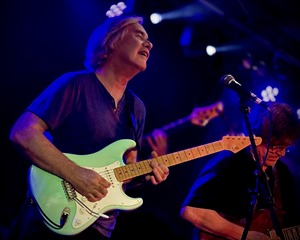
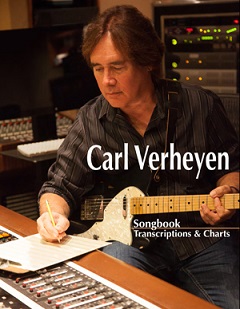
Carl Verheyen is a Los Angeles-based session guitarist who has enjoyed a long and distinguished career as a solo artist, songwriter, and producer. Also known for his work with Supertramp, he is admired for his exceptional technique and musical versatility, while continually exploring new possibilities for the guitar. Released under the Carl Verheyen Band name, his latest album, Promised Future, reflects the close musical bond he has developed with the musicians who have been performing alongside him for years. Alongside Verheyen’s outstanding guitar work, the album places equal emphasis on vocals, melodies, sophisticated harmonies, and the rich interplay of the band as a whole, resulting in a collection that is both musically diverse and deeply cohesive.
In this interview, Carl Verheyen discusses the making of Promised Future, the ideas behind its title, the arrangements and guitar work across the album, the instruments and equipment used during recording, and his thoughts on the evolving landscape of modern guitar sound.
Interview / Text Mamoru Moriyama
Muse On Muse : Promised Future showcases not only your exceptional guitar playing, but also your strengths as a vocalist and the musical interplay within the band. What were you hoping to achieve with this album, and what did you want to express musically?
Carl Verheyen : This group of musicians has been touring steadily for 3 years and I wanted to express the camaraderie and joy we have making music together. We’re all good friends and I’m so happy to have such great musicians that enjoy playing my music all over the world.
MM : Since this is an album released under the Carl Verheyen Band name, could you introduce the musicians who performed on the record and tell us a little about their contributions?
CV : You know Dave Marotta from many of my previous recordings. He’s been in the band since 1988 with a few “gap years” when it was Cliff Hugo, Stuart Hamm or Alphonso Johnson. Since 2014 ace drummer John Mader (John Fogerty, Steve Miller, Booker T. Jones, Pat Benatar, Randy Newman, and Bonnie Raitt) has played drums and percussion. Troy Dexter on keyboards and guitar (Wilson Phillips) is a multi-instrumentalist who sings and plays mandolin as well. And since 2023 vocalist Hollye Dexter (Michael McDonald, Dionne Warwick, Stephen Bishop, Christopher Cross, Don Felder) brings 4 part harmony into the mix. Our constant touring together helps to solidify arrangements before we get to the studio and I am always open to suggestions, contributions and advice! What you hear is a unique blend of all their many influences.
MM : What inspired the title Promised Future, and what does it mean to you?
CV : The political situation in the USA right now couldn’t be worse, and that song is a bit pessimistic. The same with “Shallow Harbour,” but I believe it will get better eventually.
MM : The album cover features a striking image of a futuristic city, a planet floating in a blue sky, and a windmill-like structure surrounded by greenery. What was the idea behind this artwork, and how does it relate to the album’s title or themes?
CV : I actually took that picture of the windmill in the Netherlands one day while walking through a village where we had a concert that night in an old church. To me, the windmill represents the old times, when a windmill was used to grind up grain into flour and pump water. This is before internet, cars, air travel or any of the modern things we take for granted now like light bulbs and cell phones. It’s a contrast with the future which poses a question: is the promised future really better now?
MM : How did the songwriting and recording process unfold for Promised Future? Did you develop the songs primarily on your own before bringing them to the band, or did the arrangements evolve through playing together?
CV : A little of both. I have a home studio now so I can spend more time developing the ideas before taking them on the road and opening them up with the rhythm section. Playing the songs live really helps to see what works and what needs rethinking!
MM : You also recorded at Sunset Sound, a legendary studio with a rich recording history. What do you particularly like about working there, and how does the studio influence the sound or atmosphere of a recording?
CV : Sunset Sound is what I call a “temple of tone.” I like all 3 rooms but tend to book studio 2 the most. That’s where those early Van Halen records were done, and I use the same microphones and amp placement that Ted Templeman used on Eddie.
MM : On the opening track, “Every 20 Seconds,” your vocals blend beautifully with Hollye Dexter’s vocals and the backing vocals. What led you to use this vocal arrangement, and how did you approach creating the interplay between the different vocal parts?
CV : Recently I got turned on to the 70’s era band Delaney and Bonnie. They were really active in the LA area in the early 70’s and eventually went on to become the Derek and the Dominos band that Clapton used on the Layla album. Delaney and Bonnie Bramlett, the husband and wife vocalists were so soulful and great together, I was looking for that sound. Hollye is such a natural harmonizer, it’s really easy to sing with her, and she makes me a better singer, every show!
MM : The guitar solo on the title track, “Promised Future,” is particularly captivating, with its carefully shaped phrases and beautiful sense of development. How did you approach constructing this solo? Did you work out the phrasing in advance, or did it evolve more spontaneously during the recording process?
CV : Most of it was one take, just improvising. But I punched in the last flurry of triplets and the harmonized it. After working on the rhythm parts and various layers of keyboards, vocals and guitars, I get so familiar with the vibe of the tune that the solo seems effortless by then.
MM : The title track also features a richly layered arrangement, with the rhythm guitars, keyboards, bass, and drums working together to create a cohesive sound. How did you develop the arrangement as a band, and how did you decide what each instrument should contribute?
CV : On that song we tracked it live in the studio with not only Troy on Wurlitzer piano playing 8th notes and the lick, but Jim Cox on acoustic piano. Then Troy played and organ part so there’s 3 keyboards on there. I just play the lick and sing until the solo, and after that I played a rhythm part on a Danelectro guitar.
MM : “Shallow Harbor” is a moving ballad with a strong sense of melancholy and tenderness. When playing a song like this, how do you approach your guitar parts, both in supporting the vocal melody and in shaping the solo? How do you decide when to hold back and when to let the guitar take the spotlight?
CV : I was inspired by some lyrics that Hollye wrote about the political mess that’s going on in the USA right now. I only used a few of her lines, but it inspired the rest of the words and then the music. I think melancholy is a good choice, because that’s where that minor key opening theme takes you. I recorded much of it at home using my 1965 Fender Stratocaster through my Dumble Overdrive Special, but set to clean tones. Not many guitar players who own one of these amazing amplifiers ever use them for a clean sound, but I find the overtones are very complex and beautiful. Then in the studio I played the solo on my 1968 Gibson ES-335 and played the acoustic guitars, too.
MM : Tracks such as “Survive,” “Hippie Wedding,” and “Dark Angels” are built around strong vocal melodies, yet they also reveal intricate arrangements and plenty of opportunities for expressive guitar work. How do you balance the needs of the song with your desire to explore the guitar, so that neither element overshadows the other?
CV : That’s a great question! I know that my fans want to hear top level guitar playing and listen to me for that reason alone. But I’ve made plenty of “shredder” guitar albums in my life, and I don’t think that’s where the state of the art is right now. Also, what I want to hear is harmony, both musical and vocal. My favourite records have great songs by composers like Brian Wilson, Paul Simon, Lennon and McCartney, Elton John, Burt Bacharach and many others. Their songs use great chord changes, modulations and sophisticated harmony that makes for repeated listening! I think the best way to answer your question is to state the fact that all of my songs come from the guitar. I find something interesting on guitar and develop it, like the opening line in “Survive.” After I got that I put some chords to it and then found some lyrics for the chord progression. That’s also how I wrote “Promised Future.”
MM : The live recording of “TAKE THE LONG WAY HOME” captures the band’s performance energy beautifully. Why did you decide to include a live version of this song on the album, and what did you want to capture by recording it live?
CV : Because of my many years with Supertramp, once in a while the advertisement for our concerts includes a reference to Supertramp Guitarist Carl Verheyen. On any given night there are people in our audience who think that’s what they’re going to hear. I believe we have such a unique and bluesy approach to the song that it was worth including on the album. A cover song always centers the audience with something they know and then references where I’m coming from.
MM : “Hippie Reception” is an instrumental track built around an atmospheric interplay between the rhythm section, keyboards, and guitar. Could you tell us how this piece came together and how you developed its distinctive soundscape?
CV : I’m using the harmonic pallet of “Hippie Reception” and expanding it to include some improvisation. It’s wonderful to play live because it can go any direction depending on the audience and the mood.
MM : The album closes with “Light Shine,” a song by Jesse Colin Young. What drew you to this song, and why did you feel it was the right choice to close the album?
CV : As a teenager I was really attracted to Jesse’s voice. It was really special for me and at age eighteen I wrote to him asking if I could be in his band! I told him that I knew all his songs, including the ones by the Youngbloods, his former band. To my astonishment he wrote me back a postcard telling me he had just hired a saxophone player but would “keep my name on file.” The funny this was, I kept that postcard all these years and when I finally met him in 2024 I showed it to him and we had a very nice talk. I have a wonderful career in music, and he was a very inspiring part of it. It was nice to let him know that just a year before he passed away.
MM : Your guitar playing on Promised Future is as expressive as ever, and the guitar tones throughout the album are equally impressive. What guitars, amplifiers, and pedals did you use on the record, and how did you approach shaping the tones for different songs?
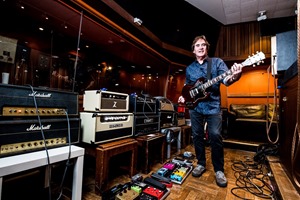
CV : I’m fortunate to be doing this for so long that by now I have a great collection of instruments, amps and pedals. I used my Fender Princeton Reverb amps and a Tremolux. I used a pair of 1964 Vox AC-30s on “Hippie Wedding” with a 1966 Rickenbacker 330. That’s my 1968 Gibson ES-335 and Dumble Overdrive Special on the solo for “Shallow Harbor.” I played my ’65 Fender Stratocaster through the Dumble for the clean tones on that one and “Light Shine.” The version of “Take the Long Way Home” was recorded at a small theatre in LA called Alva’s Showroom. You’re hearing my live rig which is the Dumble and a ’69 Marshall 100w for the distortion side. Then using an A/B switch I can jump to the clean side which is a ’75 HiWatt 100w and the ’66 Fender Showman. I played a lot of parts on my LsL signature Strats and a few solos like “Promised Future” and “Every 20 Seconds.” That’s a 1954 Les Paul Gold Top solo on “Light Shine,” and a Danelectro guitar playing the chimey solo. For “Dark Angels I played a custom made baritone guitar that Allan Holdsworth gave me. I believe the state of the art in modern guitar playing/recording is textures. I love mixing all the tones!
MM : Guitar technology has evolved considerably in recent years, with digital modelers and compact all-in-one units allowing players to create sophisticated tones without relying on traditional amplifier and pedal setups. How do you view these developments, and what role do you think digital technology should play in shaping a guitarist’s sound?
CV : I took a Kemper down to Sunset Sound Studio 2 where Van Halen recorded the first two albums and profiled 28 of my amps with 5 different microphones on each. The Carl Verheyen Vintage Amp Collection is available at Sweetwater and I do use it, especially on demos. But I still believe the most important guitar parts should have some “air” around them, meaning mic-ed in a great sounding room. No digital modeler can reproduce the manipulation of sound in a “tuned” studio environment.
MM : What do you have planned for the coming months, both with the Carl Verheyen Band and in your other musical activities?
CV : I’m heading into the studio next month to produce another artist. Since I’ll be using Sunset Sound studio 2, one of my favourite rooms in town I’ll put bass and drums on one of my own new songs. There is no plans for a new record right now, but when the inspiration happens it’s good to get it down. Right now I’m in Hamburg, Germany on a tour that started in France and went to Netherlands, Belgium, Italy and back to France next week.
MM : Finally, is there anything you’d like to say to your fans?
CV : We truly want to come to Japan and talk about it all the time! Someday it will happen, I promise!
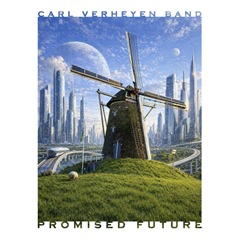
Carl Verheyen Band / Promised Future
1. Every 20 Seconds
2. Promised Future
3. Shallow Harbor
4. Survive
5. Take the Long Way Home
6. Hippie Wedding
7. Hippie Reception
8. Dark Angels
9. Light Shine