Simon Phillips
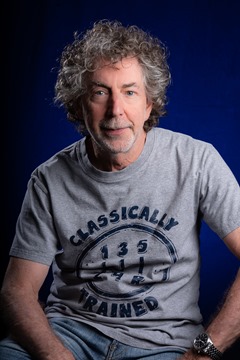
For nearly half a century, Simon Phillips has remained at the forefront of modern music as a drummer, composer, and producer. In addition to his acclaimed solo work, he is widely known for his collaborations with legendary artists such as Jeff Beck, Michael Schenker, and Toto. Now, Phillips has completed 6, the latest release from Protocol, a project that has become the ultimate expression of his musical vision.
The album is filled with outstanding performances from a group of exceptional musicians. Yet its appeal extends far beyond instrumental virtuosity and technical prowess. As Phillips himself explains, strong melodies have always been his top priority when composing instrumental music, and 6 is rich with memorable themes and dramatic musical developments that keep the listener engaged from beginning to end.
From the opening track “ANDROMEDA,” which was inspired by the warning chime of a car seatbelt alarm, to “AS THE RIVER FLOWS,” a reworking of material originally written in 1991, and the epic fourteen-minute suite “EVENT HORIZON,” the album also showcases Phillips’ remarkable creativity as a composer.
MUSE ON MUSE spoke with Simon Phillips about the making of 6, discussing its compositions, recording process, drum sounds, and the musical vision behind Protocol.
Interview / Text Mamoru Moriyama
Muse On Muse : The new album, 6, is not only filled with outstanding performances, but also features memorable melodies and dramatic musical developments that make it a captivating listen. What were you aiming to achieve with this album?
Simon Phillips : As with all my albums I strive for something different to the previous album, in this case Protocol V. I have always put strong melody as my first choice when writing instrumental music and I hope I have achieved that with Protocol 6.
MM : Compared to the lineup on V, the saxophone chair has changed from Jacob Scesney to Phillip Whack. Could you tell us how Phillip became involved in the project?
SP : Jacob is a very in demand horn player and was not always available for touring so he recommended Phillip Whack to substitute him for the shows he could not make. Therefore, Phillip was already part of the band. Jacob was not able to commit to Protocol anymore so it was an obvious choice to invite Phillip to be part of Protocol 6.
MM : The album includes four compositions written by yourself and three co-written with Alex Sill. Could you take us through the songwriting process behind these pieces?
SP : The problem was finding the time to write new music but last September I found I did have some time. The first thing I do is listen to the out-takes of the previous record and any other parts I have written since Protocol V. Frankly there wasn’t anything I was excited about so I delved further into my past and dug out an old piece of equipment from storage. It was a Yamaha QX3 midi sequencer and I still had the 3.5” discs but I didn’t know if they would still work. To my surprise they did work and I discovered some music I had written whilst still living in England. I transferred them to Pro Tools and started working on a couple of these tunes. That gave me the kick start I needed and once I started the writing would not stop. I had planned to record in November and by the end of October most of the songs were written. I sent them to Alex Sill (my guitarist) to listen to as he is really the “lead singer” of the band – but obviously he’s the guitarist. He came up with some ideas for the end of both Intrepid Traveller and Unstable Grounds which really worked well. He also sent me the first part of Sundown in Old Town and I came up with the rest. It’s a really natural writing partnership.
MM : How did the recording process unfold for this album?
SP : As always, I record the band live. It is essential for this type of music and really makes it organic and also has the energy of playing live. Once we had a master take then we would do whatever fixes are needed and then some overdubs and that’s it.
MM : “ANDROMEDA,” which opens the album, is particularly striking for its beautiful melody and dramatic sense of progression. What kind of image or concept inspired this composition?
SP : There’s a funny story to this. My car emits an alarm when the seat belts are not used. The alarm note was an F# and it was repeating in an odd meter and that’s where the whole tune started. A few hours later I had most of the composition. The solo piano intro I would say was inspired by Hiromi.
MM : “UNSTABLE GROUNDS” features a particularly compelling groove, driven in large part by Ernest Tibbs’ bass playing. Were there any specific ideas or goals you had in mind for the rhythm section on this track?
SP : I always like to have a straight forward 4/4 funk track on each album and I wanted to feature Ernest so that’s what I came up with.
MM : One of the highlights of the album is the unison lines and harmonized passages performed by Alex Sill and Phillip Whack, particularly on tracks such as “INTREPID TRAVELLER” and “CODE 4 KRYPTOS.” How were those arrangements developed?
SP : “Intrepid Traveller” was inspired by Joe Zawinul’s Syndicate project. Basically, there’s only one chord throughout the verse section and the harmony is all in the melody. It’s a particular style of writing which Joe was known for and it was a challenge that I wanted to undertake.
“Code 4 Kryptos” was more of a prog rock inspired composition using a John Barry compositional style (James Bond chords for instance) but then has a Celtic type melody in the bridge section.
MM : “AS THE RIVER FLOWS” contains rhythmic elements that evoke African music.
SP : This was originally written in 1991 – another QX3 midi sequence I found. I only used two sections of the original composition but I totally re-harmonized the tune. The drum pattern is also new and actually came last after the tune was written.
MM : Have you been influenced by traditional music or percussion-based rhythms from different cultures around the world? If so, how do you incorporate those influences into Protocol’s music?
SP : I am influenced by all music that I hear and somehow it creeps into Protocol music. If you listen to Protocol 1 (from 1988) the title tune was based on a Gamelan pattern – so World music is very much an influence in my music.
MM : “EVENT HORIZON” is an epic, suite-like composition that stretches over fourteen minutes. How did you approach structuring such an ambitious piece?
SP : It was never meant to be that long!!! But it just would not stop writing itself – ha ha ha!
After about 6 minutes of the composition I thought “well – why not write a suite” and therefore it just kept coming with ideas.
MM : “SUNDOWN IN OLD TOWN” unfolds melodically through the interplay of guitar, saxophone, and piano, bringing the album to a beautifully understated close. What made you choose this piece as the album’s final track?
SP : This was the tune that Alex Sill sent to me and I added my ideas until we had the composition. His opening melody is just so beautiful that it was inspiring to complete the composition. After hearing “Event Horizon”
I felt this would be a lovely way to end the album.
MM : With 6, Protocol has now reached its sixth album. In what ways do you feel the band has evolved over the years?
SP : It has evolved in many ways. My writing has changed and I hope for the better. Even though the album has some complex music it has more space and is more listenable in some ways. I am also very happy with the sound of the album.
MM : How do you shift your mindset as a drummer when supporting a vocalist versus performing in an instrumental setting such as Protocol?
SP : I don’t even think about it. The music tells me what I need to play. Think of it as the guitar being the vocalist. When I wrote the music with Tony Hymas for Jeff Beck it was the same approach. Jeff was the “singer”. The way he played those melodies just made them come alive. I’ve used that concept ever since “There & Back”.
MM : Throughout the album, your drum sound is exceptional. Could you talk about both your approach to drum sound and the performance techniques you feel are essential to achieving a great drum tone within an ensemble?
SP : The drum sound is totally natural. I adapt the sound to work with each tune which is done by the way I play.
The only part of the drum kit I change is the snare drum. Most of the tracks were recorded with my new signature Tama Mahogany snare drum. For other tracks I used my 1949 Slingerland, my 1939 Leady and my 1976 Ludwig Super Sensitive snare drum. Just by changing the snare drum will give the tune a different character.
MM : Within Protocol, you take on multiple roles, including drummer, composer, producer, and mixing engineer. Which of these roles do you consider the most important, and why?
SP : All of these roles a equally important. When we are tracking I am the drummer and producer. I rely on my sound engineer, Jason Mariani to take care of the sounds so I can concentrate on the production and my playing. Once it’s time for mixing then that’s when I become the engineer. The composer has done his job writing and preparing the music for the recording sessions.
MM : You have been involved in countless sessions and projects throughout your career. What does Protocol represent for you personally?
SP : Even though I love playing many different styles of music, Protocol music is closest to my heart. I have to admit though after touring with this music I really look forward to playing with a singer and playing other peoples’ music.
MM : Please give a message to your fans.
SP : I am really looking forward to coming to Tokyo to play the Blue Note once again and to present the new music to my fans. This will be my 49th visit to Japan since 1978.
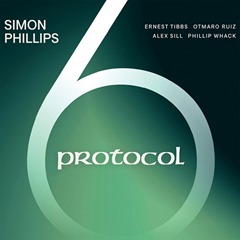
Simon Phillips / Protocol 6
1. Andromeda
2. Unstable Grounds
3. Intrepid Traveller
4. As The River Flows
5. Code 4 Kryptos
6. Event Horizon
7. Sundown In Old Town