Steve Morse
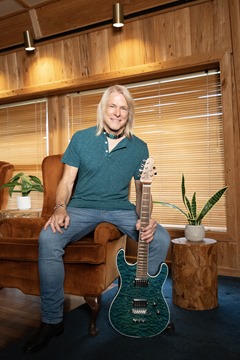
Photo by Nick Nersesov
Steve Morse, the peerless guitarist known for his work with The Dixie Dregs and for anchoring Deep Purple’s sound for many years (until his departure in 2022). has released a new album, TRIANGULATION, his first since 2009’s Out Standing In Their Field.
Funk, blues, country, jazz, classical, hard rock, across his career, Morse has moved effortlessly between styles, driven by formidable technique and a deep musical sensibility. On the new record, that range is on full display from the opening track “Break Through,” where a funk-rock riff locks in with Dave LaRue’s bass and Van Romaine’s drums, the groove snapping into place. After LaRue weaves the melody on bass, Morse answers with an addictive guitar solo, a moment that captures the essence of the Steve Morse Band. Elsewhere, “TexUS” (featuring Eric Johnson) and the title track “Triangulation” (with John Petrucci) unfold as respectful, chemistry-rich exchanges between musicians who’ve each built a singular voice of their own. Closing the album is “Taken by an Angel,” co-created with Morse’s son Kevin — a piece he describes as portraying the night his late wife passed. Its blend of sorrow, beauty, and a faint sense of grace lingers long after the final note.
We had a chat with Steve Morse with his new album TRIANGULATION.
Interview / Text Mamoru Moriyama
Translation Hiroshi Takakura
Muse On Muse : The new studio album Triangulation is the first Steve Morse Band studio release in about sixteen years. What led to putting out a new album at this timing?
Steve Morse : After all the huge changes in my life, I realized that I needed to pour myself back into a project like an album. Dave LaRue lives near me, and he agreed to come over many times to try the parts that I would present each time. Van was very much in favor of doing the album, also. I think we all missed being together and this was a perfect solution.
MM : What made you choose Triangulation as the album title?
SM : It’s a long story, but we started with some artwork ideas that Bill Evans had created for album covers, and he had made one that caught my eye with the title of “Breakthrough”. It was that humanoid figure trying to break through the wall, and Bill was using the existing painting of that from an artist, Zdzisław Beksiński. Bill got permission to use it and shape it to our needs. Well, Joe Bonamassa’s new album was already called Breakthrough, so we looked for more ideas. I really liked the artwork, and asked Bill if he could make 3 different frames of the humanoid’s progress through the wall. The top one is looking at the angles of the other two frames, to find a solution. Triangulation is a mathematical or geometry technique for finding the solution based on the angle to 2 other known points. Since we are a trio, it fit!
MM : The illustrated artwork on the album cover is very unique and visually striking. Could you tell us about the concept behind the cover art?
SM : I guess I already answered above…..But the main thing is that band members look to the other two to find where the time is, what kind of ideas to play, and lots of things, so we refer to each other to find our solutions, like Triangulation.
MM : The album captures a live energy and the kind of improvisational feel that only a real band can create. How do you usually approach the writing process? Do you bring fully written, detailed ideas or demos to the band in advance, or do you present the basic framework and then develop the ideas together while playing as a band?
SM : There are 4 ways that I write: Compose entirely on guitar, using guitar along with synth bass and keys that I program, playing and experimenting with parts that I record and play along with, and sitting and playing with live musicians. Dave was able to come by for every new part that I wrote, and we learned and played them together using a crude recording to help me remember. Then, we make a model of the piece on computer using audio files, send it to Van. He learns it, then flies down to us and we all play together and make changes. Some tunes, like Taken by an Angel, or March of the Nomads, were already written and my parts recorded, and then overdubbed their parts. But most were done as a group in the final rehearsals, at the very least.
MM : The opening track “Break Through,” which also has a music video, is classic Steve Morse Band – heavy, grooving rhythm guitars, bass and drums, and a driving lead guitar weaving a uniquely addictive melody in the best possible way.
SM : I’m very happy with that tune, because I really wanted Dave to play the melody on bass, and it worked very well. I love the swinging feel that Van always does with this kind of funk/rock riff. We played this every night on our first tour leg this year.
MM : On “Off the Cuff,” it’s very cool how Dave LaRue’s bass steps out front with those beautiful phrases. What were you aiming for with this track, especially in terms of how you featured the bass?
SM : I really wanted people to see what incredible range Dave has on the instrument. He can play any part, for sure, but his soloing is very advanced, and melodic! For a guitar album, we probably have more bass soloing than others, but when you have a guy like Dave, it’s fun to let him rip!.
MM : On “TexUS,” both your guitar playing and Eric Johnson’s are full of individuality, and the lines you spin together are truly captivating for the listener. How did this collaboration and this tune come about?
SM : I knew Eric since right after he left the ElectroMagnets in Texas in the 70’s. We did tours together back then, and I just remember a certain sound, a feeling of fun, energetic, melodic rock playing, and that’s what I tried to bring with this tune. I had a different tune ready for him, but after he said “Yes, I’d be glad to do it”, I thought that maybe I could do something that would suit Eric’s playing style better. I think there’s melody in it from beginning to end, which I love.
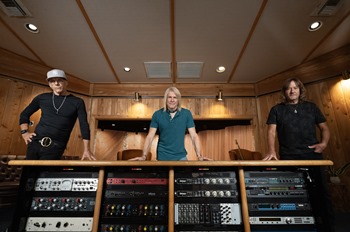
Photo by Nick Nersesov
MM : Please tell us about the title track “Triangulation,” which features John Petrucci. His playing on this song radiates a deep respect for you. How did you approach this piece together?
SM : This was a tough one: for me to get up the courage to ask him. Because old friends (since the 80’s) will sometimes say ‘Yes’ even though they are too busy and have enough to do. Dream Theater was going full speed and I didn’t want to make him feel obligated, but I finally did when I realized that we may never make another album, depending on how things work out. He and I had started writing a song together years ago, but we both got so busy that we never finished it. So, I had this tune ready, and I chopped up the melody into a duet format, and arranged the tune for both solo sections. He did so fantastic, the way he played off my melody, then set up the next section for me to answer, and so on. His solo is ridiculous, absolute perfection. Nobody can do what JP does!
MM : I was really moved by “Taken by an Angel,” which features your son Kevin. It carries a sense of sadness and beauty, and at the same time a feeling of peace and salvation. Could you talk about this piece and how it came together?
SM : Yes. The ending part I had tried with Purple and it wasn’t suitable for the band, but I remembered how perfectly it would portray the arrival and departure of an Angel taking a precious soul to a better place. For my wife’s memorial service, my son and I came up with part before that, and we played them together and it worked well. Finally, Kevin, my son, suggested putting it on the album, so I decided that it might be a good idea if I could make the piece describe the last night I spent with my wife after knowing that her cancer had suddenly come back and was quickly ending her life. The opening of the piece describes that despair and loneliness of being alone in the night talking to somebody who may or may not be able to hear you, telling them the depth of your sorrow and love, trying to comfort them at the same time, if that makes sense. It ends with the high melodic guitars screaming out as the process is over.
MM : Please tell us about your gears. What guitars, amps, effects and pedals you used on the album?
SM : My Musicman guitar, of course. I also used my Buscarino classical and a Steinberg 12 string (old and rare, but it stays in tune). My signature ENGL 100w head, and also my signature 20w head which was plugged in to the direct line in using the built in I.R. emulators….this I used to double some parts which were recorded with the 100w head using the Royer ribbon mic. Kealey compressor pedal, for some things, TC electronics flashback delays with my delay toneprint. So, nothing too unusual for me.
MM : By the way, how is the arthritis in your right wrist these days? We’ve heard that you’ve made various adjustments to your picking form to help deal with the pain when you pick. Could you tell us about that?
SM : I did switch to more stiff wrist for practicing, but during our last tour, I found that I had to go back to my old technique for some parts, in order to make the string jumps accurately. I’ve just done some radiation therapy on the bone surfaces, but I’m going to have to stop playing for awhile to see if it did any good! I’ve never stopped playing in 60 years! Instead, I will stop using my RH wrist, and try to learn to play electric guitar with my fingers (without thumb) until I know if the radiation has a chance of helping. That’s the plan, but plans are subject to change depending on what comes next!
MM : Even if you have to hold back a bit on your picking technique because of the pain in your wrist, you have such an extraordinary overall command of the instrument, and above all a great gift for writing music. As a composer and as a musician in the broader sense, it feels like there’s absolutely no problem at all. How do you yourself see the balance between physical technique and musical expression?
SM : I am about to find out, what the balance between technique and expression. I know that I can keep writing and recording, and even playing, with some limitations, so I will keep looking forward to that. When we have an obstacle, we have to move it or go around, and I’m trying to do both!
MM : What are your plans going forward?
SM : Looking forward to more writing with my son, Kevin, and possibly playing some of the new stuff together. Angel Vivaldi, who played the tour in the SMBand as the 2nd guitarist, has some ideas for me doing more online presence. I enjoy teaching, and possibly do more of that.
MM : Please give a message to your fans.
SM : Your beautiful culture and impressively high standards make you good at everything, so don’t be afraid to jump in and try to tackle your musical dreams. Excellence in playing begins with excellence in everything before, so raise your expectations of simple tasks to the best you can deliver. But if you just like to play around, go have fun with an instrument and don’t have stress!
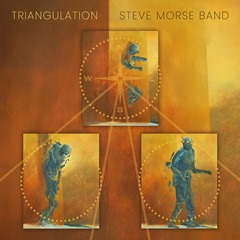
STEVE MORSE BAND / TRIANGULATION
1. Break Through
2. Off the Cuff
3. TexUS (feat. Eric Johnson)
4. The Unexpected
5. March of the Nomads (feat. Scott Sim)
6. Ice Breaker
7. Tumeni Partz
8. Triangulation (feat. John Petrucci)
9. Taken by an Angel (feat. Kevin Morse)